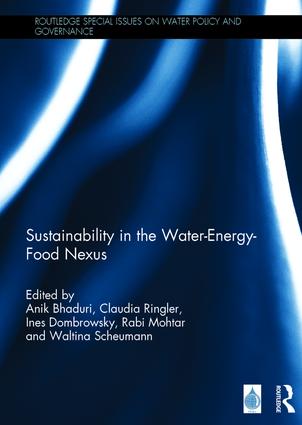
Sustainability in the water-energy-food nexus
Anik Bhaduri / Claudia Ringler / Ines Dombrowsky / Rabi Mohtar / Waltina Scheumann (eds.)Book Publications (2017)
Abingdon, UK: Routledge
ISBN: 978-1-13822-207-6
Information
Today we are more than ever convinced that security in food, energy and water is interwoven with human, economic and environmental sustainability, and that this interplay is strengthening under growing natural resource scarcity and climate change. This recognition suggests that policy making and decision making for sustainability could benefit from a holistic nexus approach that reduces trade-offs and builds synergies across sectors, and thus helps reduce costs and increase benefits for humans and nature, as compared to independent approaches to the management of water, energy and food, without compromising the resource basis on which humanity relies. In the past, research and policy work related to the nexus has looked at the interactions between water and food or water and energy, but given political and institutional realities there has been a reluctance to bring forward a broader systemic perspective to capture the dependencies across multiple sectors and resources. At the same time, the cost to the environment of neglecting these linkages has increased. The players in the nexus approach are public, private and civil society at local and broader human scales. Recognizing the urgent need to focus on sustainability in the water–energy–food nexus (WEF nexus) together with tools to analyze and approaches to govern the linkages at different scales, the Global Water System Project, the United Nations Environment Programme, the Deutsches Institut für Entwicklungspolitik, the Center for Development Research (ZEF), University of Bonn, and the CGIAR Research Program on Water Land and Ecosystems organized an international conference, Sustainability in the Water-Energy-Food Nexus, in Bonn, Germany, in 2014. This volume addresses sustainability in the WEF nexus as a key research-for-action initiative, and included an international policy consultation process to inform, influence and catalyze action of policy makers, nongovernmental organizations, the private sector, educators and researchers towards a nexus approach that both draws on and supports the environment.
About the IDOS author

Further IDOS experts
-
Baumann, Max-Otto
Political Science
-
Baydag, Melis
Political Science
-
Berensmann, Kathrin
Economy
-
Bergmann, Julian
Political Science
-
Breuer, Anita
Political Scientist
-
Büscher, Chris
Development studies / Political ecology
-
Dang, Vy
Political Science
-
El-Haddad, Amirah
Economy
-
Erforth, Benedikt
Political Science
-
Fasold, Maximilian
Political Economy
-
Furness, Mark
Political Science
-
Grimm, Sven
Political Science
-
Hackenesch, Christine
Political Science
-
Haldenwang, Christian von
Political Science
-
Herrfahrdt-Pähle, Elke
Economist
-
Hilbrich, Sören
Economy
-
Hornidge, Anna-Katharina
Development and Knowledge Sociology
-
Houdret, Annabelle
Political Scientist
-
Janus, Heiner
Political Science
-
Keijzer, Niels
Social Science
-
Koch, Svea
Social Science
-
Leininger, Julia
Political Scientist
-
Löpelt, Sarah
International relations and Sustainability policy
-
Mchowa, Chifundo
Development Economics
-
Morare, Ditebogo Modiegi
Political Science
-
Möschl, Tim
Governance
-
Nowack, Daniel
Political Science
-
Okechukwu, Nneka
Public International Law
-
Olekseyuk, Zoryana
Economy
-
Roll, Michael
Sociology
-
Schiller, Armin von
Political Science
-
Sommer, Christoph
Economist
-
Toto, Elisa Priscilla
Sustainable Development
-
von Haaren, Paula
Development Economics
-
Wagner, Niklas
Climate & Knowledge Sociology
-
Walle, Yabibal
Development Economics
-
Wehrmann, Dorothea
Sociology