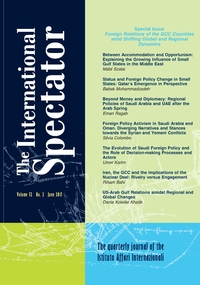
Changing hydropolitical relations in the Nile basin: a protracted transition
Tawfik, RawiaExternal Publications (2016)
in: The International Spectator 51 (3), 67-81
A new hydro-political order is emerging in the Nile Basin. Upstream riparian states have improved their bargaining power vis-à-vis downstream countries by adopting a common position in the negotiations over a new framework agreement to govern the utilisation of the Nile waters. Some upstream riparians have unilaterally constructed hydraulic projects that threaten Egypt’s hegemonic position in the basin, the most notable of which is the Grand Ethiopian Renaissance Dam (GERD). Whether these developments will lead to a more equitable utilisation of water resources and a more cooperative order will depend on the policies of the riparian states, especially in the Eastern Nile. Respect of the Declaration of Principles on the GERD signed between Egypt, Ethiopia and Sudan could help build trust between the three countries after years of tensions around the project. Beyond that, a basin-wide plan for the utilisation of water resources would not only maximise the benefits from the river and address the common challenges facing the basin, but also reduce the political costs of tensions on future projects.
Further IDOS experts
-
Baumann, Max-Otto
Political Science
-
Baydag, Melis
Political Science
-
Berger, Axel
Political Science
-
Bergmann, Julian
Political Science
-
Brandi, Clara
Economy and Political Science
-
Dang, Vy
Political Science
-
Erforth, Benedikt
Political Science
-
Furness, Mark
Political Science
-
Grimm, Sven
Political Science
-
Hackenesch, Christine
Political Science
-
Janus, Heiner
Political Science
-
Keijzer, Niels
Social Science
-
Koch, Svea
Social Science
-
Kornher, Lukas
Economics
- Kötter, Elizabeth Chepkemboi
-
Löpelt, Sarah
International relations and Sustainability policy
-
Olekseyuk, Zoryana
Economy
-
Stender, Frederik
Economics
-
Vogel, Tim
Economy
-
von Haaren, Paula
Development Economics