
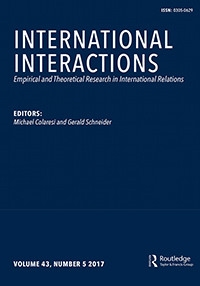
The dynamics of mass killings: testing time-series models of one-sided violence in Bosnia
Schneider, Gerald / Margit Bussmann / Constantin RuheExternal Publications (2012)
in: International Interactions 38 (4), 443-461
Many observers contend that wartime civilian victimization is an instrument of political leaders to achieve a particular goal. This article examines whether retaliation for similar acts by the other side, the developments on the battlefield, or the behavior of international actors accounts for the ups and downs of this so-called one-sided violence. Using information from the Konstanz One-Sided Violence Event Dataset and other sources, we evaluate the empirical relevance of these complementary models statistically. Time series analyses of the weekly number of killed and harmed Muslims (Bosniacs) and Serbs during the Bosnian civil war support the military and the massacre logic. We show that the Serbian side decreased one-sided violence following a territorial conquest, but that its one-sided violence was not a reciprocal response to the Bosniac targeting of civilians. Conversely, the Bosniac side resorted to violence during times of increasing Serbian atrocities and when the fighting was particularly intense. The analysis reveals that most international interventions did not reduce the carnage, but that the Serbs responded to Russian moves.
About the IDOS author

Further IDOS experts
-
Baumann, Max-Otto
Political Science
-
Hackenesch, Christine
Political Science
-
Hilbrich, Sören
Economy
-
Janus, Heiner
Political Science
-
Keijzer, Niels
Social Science
-
Koch, Svea
Social Science
-
Mathis, Okka Lou
Political Scientist
-
Schwachula, Anna
Sociology
-
Srigiri, Srinivasa Reddy
Agricultural Economist
-
Vogel, Johanna
International Cultural Economy
-
von Haaren, Paula
Development Economics
-
Wehrmann, Dorothea
Sociology