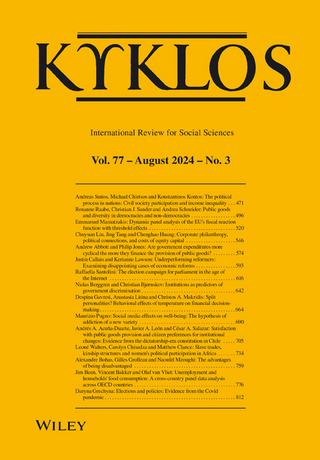
Unveiling the mutual dynamics: institutions, education and economic growth over 138 years in OECD countries
Röthel, Tim / Martin LeschkeExternal Publications (2024)
in: Kyklos, first published 23.09.2024
DOI: https://doi.org/https://doi.org/10.1111/kykl.12416
Open access
Many articles examine the effect of institutions and education on economic growth in growth models or empirical settings. However, the opposite effect of economic development on institutions and education is less researched. Systematic evidence is scarce when looking at the interplay of education and institutions. Most of the literature focuses on post-war evidence starting in the 1960s only. However, institutions and education, both, only change slowly over time and, thus, should be analysed over a longer period. In this article, we try to close a gap by examining the relationship between all three variables over 138 years. By estimating a vector error correction model for a sample of 20 Organisation for Economic Co-operation and Development (OECD) countries, we are additionally able to differentiate between short- and long-run results. We find positive effects of institutions and education on growth and vice versa. In contrast, institutions and education do not significantly affect each other. Our results are robust to several robustness tests and extensions.
About the IDOS author

Further IDOS experts
-
Altenburg, Tilman
Economic Geography
-
Asimeng, Emmanuel Theodore
Urban Planning, Sustainability
-
Burchi, Francesco
Development Economy
-
Christ, Simone
Social Anthropology
-
El-Haddad, Amirah
Economy
-
Herrfahrdt-Pähle, Elke
Economist
-
Jaji, Rose
Anthropology
-
Loewe, Markus
Economy
-
Nowack, Daniel
Political Science
-
Roll, Michael
Sociology
-
Sommer, Christoph
Economist
-
Sowa, Alina
Economics
-
Strohmaier, Rita
Economy
-
Stöcker, Alexander
Economics
-
Vogel, Tim
Economy
-
Zintl, Tina
Political Scientist