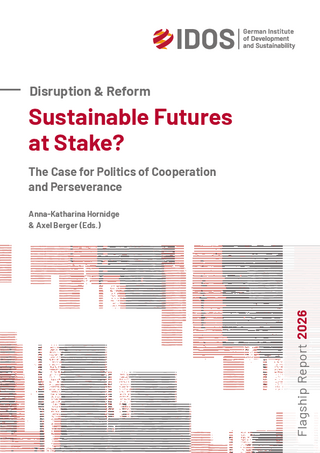
Global health beyond 2030: protecting ambition in a fragmented world
von Haaren, Paula / Christoph Strupat / Srinivasa SrigiriStaff - Other (2026)
in: Anna-Katharina Hornidge / Axel Berger (eds.), Disruption and Reform: sustainable futures at stake? The case for politics of cooperation and perseverance, Bonn: German Institute of Development and Sustainability (IDOS), 56-61
ISBN: 978-3-96021-292-8
DOI: https://doi.org/10.23661/r4.2026
The Sustainable Development Goals (SDGs) were agreed in 2015 in a political environment in which broad multilateral agreement still appeared possible. They reflected the belief that universal goals, shared language and collective implementation could organise international cooperation, even if
they were never free from contestation (Biermann, Kanie, & Kim, 2017; Chaturvedi et al., 2020). For global health, this mattered. The 2030 Agenda broadened the health agenda beyond selected infectious diseases and maternal and child health. It included universal health coverage, non-communicable diseases, mental health, sexual and reproductive health and rights, and the wider social, economic and environmental determinants of health (Murray, 2015; WHO, 2015). With only a few years left until 2030, progress remains uneven and many health-related targets are off track. At the same time, the political context for a future global development framework has changed substantially. Global health cooper-
ation is increasingly shaped by donor retrenchment, weaker multilateralism, geopolitical competition and ideological polarisation (Held, Kickbusch, McNally, Piselli, & Told, 2019; Kickbusch & Liu, 2022). Issues such as gender equality, vaccination, climate action and migration have become more contested. These tensions now affect financing, normsetting, institutional stability and the conditions under which cooperation remains possible. Three shifts are particularly important. First, financing has become more uncertain. Aid cuts and donor retrenchment weaken multilateral health institutions and create incentives for selective, interest-driven cooperation (Poddar & Rao, 2025; Witter et al., 2025). Second, ideological polarisation makes established health commitments more contested, especially around sexual and reproductive health and rights, vaccination, and climate and health (Greene, 2026; Khosla & Allotey, 2025). Third, the global health order is becoming more multipolar. Regional organisations, middle powers,
South-South cooperation and issue-based coalitions are gaining influence (Bull & Banik, 2025; Franz et al., 2024; Lal, 2026). Together, these shifts affect who leads, which priorities are defended and how ambition is defined. At stake is not only whether new commitments can be agreed, but whether the core principles of global health cooperation can be preserved. These include rights-based commitments, universality and equity, national ownership in implementation and international solidarity through coordinated collective action. These principles are grounded in the normative framework of the World Health Organization (WHO) and reflected, although unevenly, in the 2030 Agenda and subsequent declarations on universal health coverage (UN, 2015, 2019, 2023; WHO, 1948). The risk is not only stagnation. A more serious risk is selective rollback. Commitments that seemed relatively stable during the SDG period may become vulnerable in post-2030 negotiations. This applies particularly to sexual and reproductive health and rights, vaccination and climate-related health commitments (Haeuser et al., 2025; Khosla & Allotey, 2025; Romanello et al., 2024). If consensus becomes harder to reach, the price of agreement may be dilution. A future framework may preserve the language of multilateralism while narrowing the substance of global health ambition (see also Berger & Leininger in this volume).
About the IDOS authors


Further IDOS experts
-
Baumann, Max-Otto
Political Science
-
Hackenesch, Christine
Political Science
-
Hilbrich, Sören
Economy
-
Janus, Heiner
Political Science
-
Keijzer, Niels
Social Science
-
Koch, Svea
Social Science
-
Mathis, Okka Lou
Political Scientist
-
Schwachula, Anna
Sociology
-
Vogel, Johanna
International Cultural Economy
-
Wehrmann, Dorothea
Sociology