New Delhi, 05. März 2026
The Research and Information System for Developing Countries (RIS) , New Delhi and German Institute of Development and Sustainability (IDOS) are organising a Roundtable Discussion to deliberate on the strategic, trade, and regulatory dimensions of the India–EU FTA. The dialogue will examine its potential to deepen economic integration,…
Keijzer, Niels / Julian Bergmann (2019) Externe Publikationen
Barchiche, Damien / Elise Dufief / Niels Keijzer / Yvonne Lobos Alva / Georghe Marbuah (2023) Externe Publikationen
Marschall, Paul / Stephan Klingebiel (2019) Analysen und Stellungnahmen 6/2019
Populistische Tendenzen bergen erhebliche Risiken für die Bearbeitung von grenzüberschreitenden Herausforderungen. Staaten mit starkem populistischem Zuspruch können Bremser einer nachhaltigen globalen Entwicklung sein. Deswegen sollten davon weniger betroffene Staaten wichtige Funktionen wahrnehmen.
Ittner, Irit / Sneha Sharma / Isaac Khambule / Hanna Geschewski (eds.) (2024) Buchveröffentlichungen
Klingebiel, Stephan / Dirk Messner / Imme Scholz (2017) Externe Publikationen
Negre, Mario / Mark Furness (2012) Die aktuelle Kolumne, 07. Mai 2012
Lundsgaarde, Erik / Svea Koch / Julia Leininger (2014) Die aktuelle Kolumne, 31. März 2014
Vom 2. bis 3. April kommen Staats- und Regierungschefs der Europäischen Union (EU) und Afrikas in Brüssel zusammen, um eine Zwischenbilanz ihrer bisherigen Zusammenarbeit zu ziehen und künftige Arbeitsschwerpunkte zu setzen.
Negre, Mario (2013) Die aktuelle Kolumne, 06. Mai 2013
Keijzer, Niels / Julian Bergmann (2024) Externe Publikationen
Messner, Dirk / Friedrich-Wilhelm Beimdiek / Wolfram Stierle / Jürgen Zattler (2018) Externe Publikationen
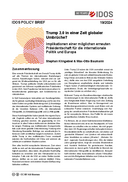
Klingebiel, Stephan / Max-Otto Baumann (2024) Policy Brief 19/2024
Die Auswirkungen einer erneuten Präsidentschaft von Donald Trump dürften für alle Themen der internationalen Beziehungen von enormer Bedeutung sein. Wir fokussieren auf Handlungsfelder, die für globale nachhaltige Entwicklung und für den Globalen Süden besonders wichtig sind.
Gonsior, Victoria / Stephan Klingebiel (2020) Externe Publikationen
Klingebiel, Stephan (2015) Externe Publikationen
Online, 26. Oktober 2021
This is the 9 th of a webinar series on investment facilitation for development, held in the framework of a joint ITC/DIE project on Investment Facilitation for Development. Like all ITC/DIE events, participation in the webinar is free of charge. However, it is necessary to register for the event in order to receive the meeting link…
Online, 19. November 2020
We were excited to welcome researchers and policy makers from more than 29 countries to reflect on the last four years of the Action and to discuss new developing topics and upcoming challenges to the future of our oceans through a series of scientific panels, as well as keynotes featuring: Edward H Allison , Principal Scientist at…
Wingens, Christopher / Paul Marschall / Eva Dick (2021) Briefing Paper 17/2021
Municipal development policy is growing in significance in Germany. Cities, districts and local authorities are working with numerous stakeholders to enhance their engagement in this field. The activities are being well received and having an impact in Germany and abroad.
World Bank Group and German Development Institute broaden partnership to tackle global poverty and inequality World Bank Group and German Development Institute broaden partnership to tackle global poverty and inequality Press Release of 22 June 2015 Ending extreme poverty is one of the most important issues on the international agenda, and is central to the Sustainable Development Goals, which will be adopted by the United Nations General Assembly in September 2015.…
Ragoussis, Alexandros (2019) Die aktuelle Kolumne, 27. Mai 2019
In der Internationalen Entwicklungszusammenarbeit wird der private Sektor oft als der große Chancengeber für die ökonomische Entwicklung fragiler Staaten herbeigesehnt. Doch die Realität ist ernüchternd.
Hilbrich, Sören (2019) Die aktuelle Kolumne, 21. Oktober 2019
Entscheidungen in der Global Governance werden vor allem von wohlhabenden Ländern gefällt. Für Institutionen, die globale öffentliche Aufgaben erfüllen, ist das kaum zu rechtfertigen.