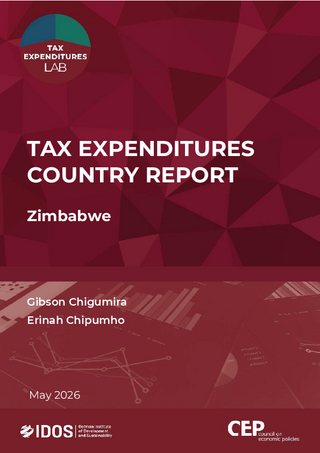
Tax expenditures country report: Zimbabwe
Chigumira, Gibson / Erinah ChipumhoBuchveröffentlichungen (2026)
Bonn/Zurich: German Institute of Development and Sustainability (IDOS) and Council on Economic Policies (CEP)
DOI: https://doi.org/10.23661/cr1.2026
Tax expenditures (TEs) in Zimbabwe represent a significant portion of government spending, amounting to 2.8 percent of GDP, 24.7 percent of total revenue, and 21.2 percent of public spending in 2023. Companies benefitting from TEs enjoy tax savings that trigger a reduction in government revenue, which may in turn result in higher budget deficits and sovereign debt. TEs are often regressive, e.g., when TEs related to personal income tax (PIT) benefit those in higher income tax brackets more, and TEs related to value-added tax (VAT) provide a larger benefit to higher income households, given their larger consumption in absolute terms. Although TEs are meant to boost investment, exports, innovation and employment, their real impact is often unknown, as Zimbabwe lacks a culture of ex-ante and ex-post evaluation of TEs.
Transparency: Section 3 of the Public Finance Management Act [Chapter 22:19] aims to secure transparency, accountability and sound management of revenues and expenditure, but does not provide specific provisions on TEs assessments nor reporting to the Parliament of Zimbabwe. Section 30 of the Zimbabwe Investment Development Agency (ZIDA) Act also highlights that ZIDA, in consultation with the Minister responsible for Finance, should publish guidelines for investment, which include general and special incentives applicable to specific categories of licensed investors. Against this backdrop, it is fair to say that there is no explicit policy on TE transparency in Zimbabwe.
Complex landscape: The rationale for the introduction of business-related TEs is to stimulate investment and production, which should then create employment opportunities and other benefits, potentially leading to higher government revenues in the medium or long term. If well-designed, tax incentives for investment can be a cost-effective policy tool. However, TEs may be vulnerable to lobbying and abuse, providing preferential tax treatment to specific groups with vested interests to keep the incentives in place even without much benefit to the economy at large. Empirical evidence on TEs is still limited in Zimbabwe, which undermines evidence-based tax policymaking.
Evaluation challenges: The government of Zimbabwe committed to develop a tax incentive monitoring and evaluation framework, managed by the Zimbabwe Revenue Authority (ZIMRA), to facilitate the management of TEs and inform cost-benefit analyses by Treasury on an annual basis with effect from 1 January 2019. No ex-ante evaluation has been conducted so far, but some ex-post evaluations of TEs were undertaken in 2021 and 2023. In addition, ZIMRA has started to publish TE figures from 2019 onwards in its annual reports, although the statistics published are highly aggregated and do not cover all taxes upon which TEs are granted. The published TEs from the annual reports are revenue forgone from domestic and trade taxes. Although the Parliament of Zimbabwe has the competence to oversee the national budget cycle, it is currently not involved in the monitoring and control of TEs.
Fiscal sustainability: Fiscal sustainability enables governments to meet future public expenditure and financial obligations without resorting to excessive borrowing. Constitution of Zimbabwe Amendment (No. 20) Act, 2013 (Act No. 1 of 2013, Section 299) provides for Parliamentary oversight of state revenues and expenditure to ensure accountability, monitoring and fiscal sustainability (Government of Zimbabwe, 2023a). Section 298 (1) b i of the Constitution states that the burden of taxation must be shared equally which implies that TEs should not be allocated without evaluating if they are beneficial to Zimbabwe. TEs can be described as hidden government spending, which can negatively affect fiscal sustainability. Zimbabwe’s TEs amounted to US$1.34 billion in 2023, which is about 2.8 percent of GDP, compared to the global average of about 4 percent of GDP. However, VAT rate reductions and exemptions on domestic sales, which constituted 51 percent and 27.1 percent of total TEs reported by ZIMRA in 2020, were not reported through the new Tax and Revenue Management System (TaRMS) in 2023. Moreover, TEs for CIT, PIT and excise duty were not reported since they are not captured by ZIMRA. The bulk of the reported figures for 2023 were TEs related to custom duties. Thus, the extent of TE use in Zimbabwe is underreported and may in fact be considerably higher than the global average. Moreover, this is happening at a time when Zimbabwe is facing limited fiscal space, with public debt constituting 59.7 percent of GDP in 2024.
Policy recommendations: The Government of Zimbabwe should conduct or commission ex-ante and ex-post evaluations of TEs to enhance their effectiveness. Statistics on TE use and revenue forgone should be publicly available and easily accessible to enhance transparency and access of information to the users. All TEs should be time-bound (with sunset clauses) and, ideally, only be renewed after an assessment has been undertaken to justify their existence. All new TEs should be subject to an ex-ante evaluation to clarify expectations and ensure that only effective TEs are implemented in the country. The Parliament of Zimbabwe should be involved in the monitoring and control of TEs. The legislation should ensure that TE proposals are in line with national development plans and policies. The Parliament of Zimbabwe should also ensure that TE reports are published at pre-defined dates. TE reporting should be comprehensive, reported annually. This means there should be a designated authority responsible for preparing the TE report, preferably in the Ministry of Finance, Economic Development and Investment Promotion. The legal framework should also establish the structure and frequency of TE evaluations, including both ex-ante assessments and ex-post evaluations.
Weitere IDOS-Expert*innen zu diesem Thema
-
Baumann, Max-Otto
Politikwissenschaft
-
Baydag, Melis
Politikwissenschaft
-
Berensmann, Kathrin
Wirtschaftswissenschaften
-
Bergmann, Julian
Politikwissenschaft
-
Dang, Vy
Politikwissenschaft
-
Erforth, Benedikt
Politikwissenschaft
-
Fasold, Maximilian
Politische Ökonomie
-
Furness, Mark
Politikwissenschaft
-
Grimm, Sven
Politologie
-
Hackenesch, Christine
Politikwissenschaft
-
Haldenwang, Christian von
Politikwissenschaftler
-
Hilbrich, Sören
Ökonomie
-
Janus, Heiner
Politikwissenschaft
-
Keijzer, Niels
Sozialwissenschaft
-
Koch, Svea
Sozialwissenschaft
-
Löpelt, Sarah
Internationale Beziehungen und Nachhaltigkeitspolitik
-
Mchowa, Chifundo
Entwicklungsökonomie
-
Olekseyuk, Zoryana
Ökonomie
-
Schiller, Armin von
Politikwissenschaftler
-
Sommer, Christoph
Ökonom
-
Toto, Elisa Priscilla
Sustainable Development
-
von Haaren, Paula
Entwicklungsökonomie
-
Walle, Yabibal
Entwicklungsökonomie