China’s International investment agreement policy: from rule-taker to rule-maker?
Berger, AxelExternal Publications (2023)
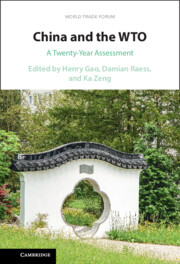
in: Henry Gao / Damian Raess / Ka Zeng (eds.), China and the WTO: a Twenty-Year Assessment, Cambridge: Cambridge University Press, 452-467
ISBN: 978-1-00-929180-4
DOI: https://doi.org/10.1017/9781009291804.026
Open access
This chapter investigates whether China assumes the role of a rule-taker, acts as a rule-maker or even breaks with the system governing foreign investment. Given its significant foreign investment flows and economic and political clout, a better understanding of China’s ideas for and potential role in the ongoing reform of global investment governance is highly relevant. An analysis of China’s international investment agreements shows that China acted as a rule-taker by broadly accepting the templates of its treaty partners, while clinging to a number of defensive positions. The most recent and significant international investment agreement negotiated by China, the Comprehensive Agreement on Investment, signed in principle with the EU, seems to be following a template that largely reflects the preferences of the EU. China is also a supporter of the World Trade Organization negotiations on investment facilitation. China’s role in the Investment Facilitation for Development (IFD) Agreement negotiations should be characterized not so much as a thought-leader but as a key promoter of dialogue and negotiations.
About the IDOS author

Further IDOS experts
-
Baumann, Max-Otto
Political Science
-
Brandi, Clara
Economy and Political Science
-
Goedeking, Nicholas
Comparative Political Economy
-
Haug, Sebastian
Political Science
-
Hilbrich, Sören
Economy
-
Kachelmann, Matthias
Political Science
-
Kornher, Lukas
Economics
- Kötter, Elizabeth Chepkemboi
-
Li, Hangwei
Political Science
-
Morare, Ditebogo Modiegi
Political Science
-
Novoselova, Anna
Political Science
-
Nowack, Daniel
Political Science
-
Olekseyuk, Zoryana
Economy
-
Stender, Frederik
Economics
-
Stewart, Benjamin
Social Science
-
Vogel, Tim
Economy
-
Volz, Ulrich
Economist
-
Wingens, Christopher
Political Science