
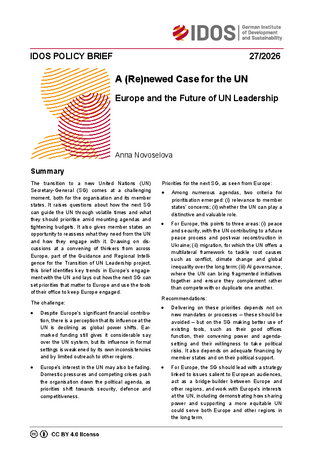
A (re)newed case for the UN: Europe and the future of UN leadership
Novoselova, AnnaPolicy Brief (27/2026)
Bonn: German Institute of Development and Sustainability (IDOS)
DOI: https://doi.org/10.23661/ipb27.2026
The transition to a new United Nations (UN) Secretary-General (SG) comes at a challenging moment, both for the organisation and its member states. It raises questions about how the next SG can guide the UN through volatile times and what they should prioritise amid mounting agendas and tightening budgets. It also gives member states an opportunity to reassess what they need from the UN and how they engage with it. Drawing on dis¬cussions at a convening of thinkers from across Europe, part of the Guidance and Regional Intelli¬gence for the Transition of UN Leadership project, this brief identifies key trends in Europe’s engage¬ment with the UN and lays out how the next SG can set priorities that matter to Europe and use the tools of their office to keep Europe engaged.
The challenge:
• Despite Europe’s significant financial contribu-tion, there is a perception that its influence at the UN is declining as global power shifts. Ear-marked funding still gives it consi¬der¬able say over the UN system, but its influence in formal settings is weakened by its own inconsistencies and by limited outreach to other regions.
• Europe’s interest in the UN may also be fading. Domestic pressures and competing crises push the organisation down the political agenda, as priori¬ties shift towards security, defence and competitiveness.
Priorities for the next SG, as seen from Europe:
• Among numerous agendas, two criteria for prioritisation emerged: (i) relevance to member states’ concerns; (ii) whether the UN can play a distinctive and valuable role.
• For Europe, this points to three areas: (i) peace and security, with the UN contributing to a future peace process and post-war reconstruction in Ukraine; (ii) migration, for which the UN offers a multilateral framework to tackle root causes such as conflict, climate change and global inequality over the long term; (iii) AI governance, where the UN can bring fragmented initiatives together and ensure they complement rather than compete with or duplicate one another.
Recommendations:
• Delivering on these priorities depends not on new mandates or processes – these should be avoided – but on the SG making better use of existing tools, such as their good offices function, their convening power and agenda-setting and their willingness to take political risks. It also depends on adequate financing by member states and on their political support.
• For Europe, the SG should lead with a strategy linked to issues salient to European audiences, act as a bridge-builder between Europe and other regions, and work with Europe’s interests at the UN, including demonstrating how sharing power and supporting a more equitable UN could serve both Europe and other regions in the long term.
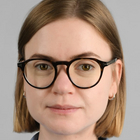
About the IDOS author
Further IDOS experts
-
Baumann, Max-Otto
Political Science
-
Berger, Axel
Political Science
-
Goedeking, Nicholas
Comparative Political Economy
-
Haug, Sebastian
Political Science
-
Hilbrich, Sören
Economy
-
Kachelmann, Matthias
Political Science
-
Li, Hangwei
Political Science
-
Morare, Ditebogo Modiegi
Political Science
-
Nowack, Daniel
Political Science
-
Olekseyuk, Zoryana
Economy
-
Stewart, Benjamin
Social Science
-
Volz, Ulrich
Economist
-
Wingens, Christopher
Political Science