
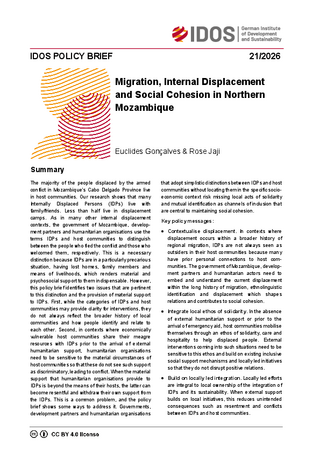
Migration, internal displacement and social cohesion in northern Mozambique
Gonçalves, Euclides / Rose JajiPolicy Brief (21/2026)
Bonn: German Institute of Development and Sustainability (IDOS)
DOI: https://doi.org/10.23661/ipb21.2026
The majority of the people displaced by the armed conflict in Mozambique’s Cabo Delgado Province live in host communities. Our research shows that many Internally Displaced Persons (IDPs) live with family/friends. Less than half live in displacement camps. As in many other internal displacement contexts, the government of Mozambique, development partners and humanitarian organisations use the terms IDPs and host communities to distinguish between the people who fled the conflict and those who welcomed them, respectively. This is a necessary distinction because IDPs are in a particularly precarious situation, having lost homes, family members and means of livelihoods, which renders material and psychosocial support to them indispensable. However, this policy brief identifies two issues that are pertinent to this distinction and the provision of material support to IDPs. First, while the categories of IDPs and host communities may provide clarity for interventions, they do not always reflect the broader history of local communities and how people identify and relate to each other. Second, in contexts where economically vulnerable host communities share their meagre resources with IDPs prior to the arrival of external humanitarian support, humanitarian organisations need to be sensitive to the material circumstances of host communities so that these do not see such support as discriminatory, leading to conflict. When the material support that humanitarian organisations provide to IDPs is beyond the means of their hosts, the latter can become resentful and withdraw their own support from the IDPs. This is a common problem, and the policy brief shows some ways to address it. Governments, development partners, and humanitarian organisations that adopt simplistic distinctions between IDPs and host communities without locating them in the specific socio-economic context risk missing local acts of solidarity and mutual identification as channels of inclusion that are central to maintaining social cohesion.
Key policy messages:
- Contextualise displacement. In contexts where displacement occurs within a broader history of regional migration, IDPs are not always seen as outsiders in their host communities because many have prior personal connections to host communities. The government of Mozambique, development partners and humanitarian actors need to embed and understand the current displacement within the long history of migration, ethnolinguistic identification and displacement which shapes relations and contributes to social cohesion.
- Integrate local ethos of solidarity. In the absence of external humanitarian support or prior to the arrival of emergency aid, host communities mobilise themselves through an ethos of solidarity, care and hospitality to help displaced people. External interventions coming into such situations need to be sensitive to this ethos and build on existing inclusive social support mechanisms and locally led initiatives so that they do not disrupt positive relations.
- Build on locally led integration. Locally led efforts are integral to local ownership of the integration of IDPs and its sustainability. When external support builds on local initiatives, this reduces unintended consequences such as resentment and conflicts between IDPs and host communities.
About the IDOS author

Further IDOS experts
-
Abedtalas, Musallam
Economics
-
Christ, Simone
Social Anthropology
-
Ekoh, Susan S.
Environmental Research
-
Flaig, Merlin
Social Science
-
Kuhnt, Jana
Development Economist
-
Martin-Shields, Charles
Political Science
-
Nowack, Daniel
Political Science
-
Putz, Lena-Marie
Peace and Conflict Research
-
Roll, Michael
Sociology
-
Roost, Stefanie
Economics
-
Sakketa, Tekalign Gutu
Agricultural / Development Economics
-
Walle, Yabibal
Development Economics
-
Zintl, Tina
Political Scientist