
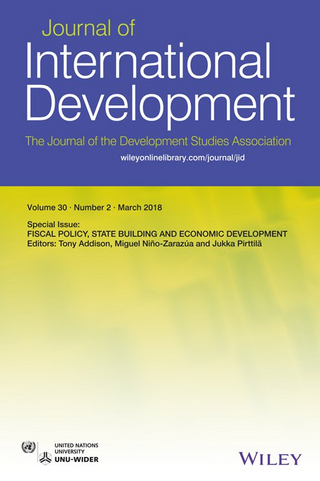
Party system institutionalization and reliance on personal income taxation in developing countries
von Schiller, ArminExterne Publikationen (2018)
in: Journal of International Development 30 (2), 274-301
DOI: https://doi.org/10.1002/jid.3347
Volltext/Document
This paper explores the effect of party system institutionalization on the relevance of personal income taxation in the tax composition. Based on a fiscal contractualism approach, I argue that institutionalized political party systems increase the capacity of political actors to commit credibly to fiscal contracts agreed with wealthy taxpayers. Consequently, especially where bureaucratic capacity is low, institutionalized political party systems should have a strong effect on the share of the tax burden that wealthy taxpayers are willing to accept. The analysis of panel data between 1990 and 2010 for a sample of over 90 countries supports this hypothesis. Party system institutionalization has a significant and strong positive effect on the relevance of the personal income taxation where bureaucratic capacity is low. At high levels of bureaucratic capacity, the effect disappears. The findings strongly support the claim that, particularly in developing countries, where bureaucratic capacity tends to be limited, taxation is best understood as a problem of credible commitment.
Über den IDOS-Autor

Weitere IDOS-Expert*innen zu diesem Thema
-
Baumann, Max-Otto
Politikwissenschaft
-
Berensmann, Kathrin
Wirtschaftswissenschaften
-
Breuer, Anita
Politikwissenschaftlerin
-
El-Haddad, Amirah
Ökonomie
-
Fasold, Maximilian
Politische Ökonomie
-
Haldenwang, Christian von
Politikwissenschaftler
-
Herrfahrdt-Pähle, Elke
Volkswirtin
-
Hilbrich, Sören
Ökonomie
-
Houdret, Annabelle
Politikwissenschaftlerin
-
Leininger, Julia
Politikwissenschaftlerin
-
Mchowa, Chifundo
Entwicklungsökonomie
-
Morare, Ditebogo Modiegi
Politikwissenschaften
-
Möschl, Tim
Governance
-
Nowack, Daniel
Politikwissenschaftler
-
Okechukwu, Nneka
Public International Law
-
Roll, Michael
Soziologie
-
Sommer, Christoph
Ökonom
-
Toto, Elisa Priscilla
Sustainable Development
-
Wagner, Niklas
Klima- und Wissenssoziologie
-
Walle, Yabibal
Entwicklungsökonomie
-
Wehrmann, Dorothea
Soziologie