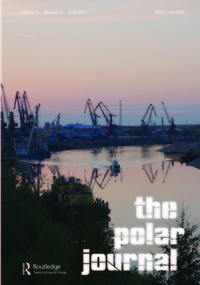
The Polar Regions as “barometers” in the Anthropocene: towards a new significance of non-state actors in international cooperation?
Wehrmann, DorotheaExterne Publikationen (2016)
in: The Polar Journal 6 (2), 379-397
Rapidly melting sea ice and thereto related access to formerly ice-covered petroleum reserves and future shipping lanes place the Polar Regions (particularly the Arctic) at the nexus of discourses on geopolitics and on the Anthropocene. Against this background, various studies across distinct fields in the social sciences have focused on polar politics mostly from a state-centric perspective but often neglected the growing significance of non-state actors in regional cooperation. This article discusses how state actors who formerly shaped and to this day dominate regional polar politics increasingly rely on the expertise, knowledge and financial resources of non-state actors (NGOs, private actors and rightsholder groups) in order to meet the complex multi-level challenges arising from environmental changes in both Polar Regions. The article relates particularly to the thematic field of oil and gas development, which is regarded as a driver of environmental changes in the Anthropocene and to which the Polar Regions (also known as “Climate Change Barometers” due to their vulnerability to environmental change) are very sensitive. As this is a current concern controversially discussed particularly in view of the changing Arctic (oil and gas development is prohibited in Antarctica at least until 2048), this article draws particularly on empirical findings from policy-making in the Arctic Council. To illustrate the scope of the argument, however, this article also considers the role of non-state actors in the Antarctic Treaty System and shows how through the inclusion of non-state actors political constellations have changed in polar politics. Against this backdrop, this article argues that the growing significance of non-state actors in polar regional cooperation indicates how the general say of state and non-state actors in international politics likely changes in the light of the age of the Anthropocene.
Über die IDOS-Autorin
Weitere IDOS-Expert*innen zu diesem Thema
-
Aleksandrova, Mariya
Climate risk governance
-
Bambe, Bao-We-Wal
Finance
-
Baumann, Max-Otto
Politikwissenschaft
-
Brandi, Clara
Ökonomie und Politikwissenschaft
-
Breuer, Anita
Politikwissenschaftlerin
-
Donnelly, Aiveen
Politikwissenschaft
-
Ekoh, Susan S.
Umweltwissenschaft
-
El-Haddad, Amirah
Ökonomie
-
Fasold, Maximilian
Politische Ökonomie
-
Fuhrmann-Riebel, Hanna
Ökonomie
-
Goedeking, Nicholas
Vergleichende politische Ökonomie
-
Hagenström, Paul
Internationale Beziehungen
-
Haldenwang, Christian von
Politikwissenschaftler
-
Herrfahrdt-Pähle, Elke
Volkswirtin
-
Houdret, Annabelle
Politikwissenschaftlerin
-
Kativu, Saymore Ngonidzashe
Geographie
-
Lehmann, Ina
Politikwissenschaft
-
Leininger, Julia
Politikwissenschaftlerin
-
Malerba, Daniele
Ökonomie
-
Mathis, Okka Lou
Politikwissenschaftlerin
-
Morare, Ditebogo Modiegi
Politikwissenschaften
-
Möschl, Tim
Governance
-
Never, Babette
Politikwissenschaftlerin
-
Nowack, Daniel
Politikwissenschaftler
-
Okechukwu, Nneka
Public International Law
-
Pegels, Anna
Ökonomin
-
Rodríguez de Francisco, Jean Carlo
Ökologische Ökonomie
-
Roll, Michael
Soziologie
-
Srigiri, Srinivasa Reddy
Agrarökonom
-
Wagner, Niklas
Klima- und Wissenssoziologie
-
Yi, HyunAh
Energie- und Umweltwissenschaften