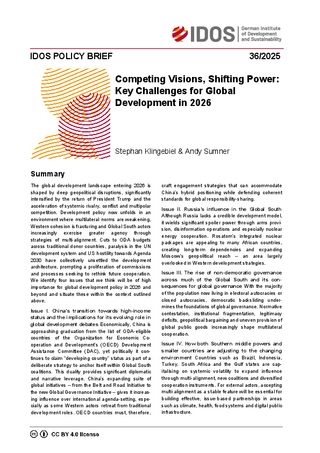
Competing visions, shifting power: key challenges for global development in 2026
Klingebiel, Stephan / Andy SumnerPolicy Brief (36/2025)
Bonn: German Institute of Development and Sustainability (IDOS)
DOI: https://doi.org/10.23661/ipb36.2025
The global development landscape entering 2026 is shaped by deep geopolitical disruptions, significantly intensified by the return of President Trump and the acceleration of systemic rivalry, conflict and multipolar competition. Development policy now unfolds in an environment where multilateral norms are weakening, Western cohesion is fracturing and Global South actors increasingly exercise greater agency through strategies of multi-alignment. Cuts to ODA budgets across traditional donor countries, paralysis in the UN development system and US hostility towards Agenda 2030 have collectively unsettled the development architecture, prompting a proliferation of commissions and processes seeking to rethink future cooperation. We identify four issues that we think will be of high importance for global development policy in 2026 and beyond and situate these within the context outlined above.
Issue I. China’s transition towards high-income status and the implications for its evolving role in global development debates Economically, China is approaching graduation from the list of ODA-eligible countries of the Organization for Economic Cooperation and Development’s (OECD) Development Assistance Committee (DAC), yet politically it continues to claim “developing country” status as part of a deliberate strategy to anchor itself within Global South coalitions. This duality provides significant diplomatic and narrative leverage. China’s expanding suite of global initiatives – from the Belt and Road Initiative to the new Global Governance Initiative – gives it increasing influence over international agenda-setting, especially as some Western actors retreat from traditional development roles. OECD countries must, therefore, craft engagement strategies that can accommodate China’s hybrid positioning while defending coherent standards for global responsibility-sharing.
Issue II. Russia’s influence in the Global South Although Russia lacks a credible development model, it wields significant spoiler power through arms provision, disinformation operations and especially nuclear energy cooperation. Rosatom’s integrated nuclear packages are appealing to many African countries, creating long-term dependencies and expanding Moscow’s geopolitical reach – an area largely overlooked in Western development strategies.
Issue III. The rise of non-democratic governance across much of the Global South and its consequences for global governance With the majority of the population now living in electoral autocracies or closed autocracies, democratic backsliding undermines the foundations of global governance. Normative contestation, institutional fragmentation, legitimacy deficits, geopolitical bargaining and uneven provision of global public goods increasingly shape multilateral cooperation.
Issue IV. How both Southern middle powers and smaller countries are adjusting to the changing environment Countries such as Brazil, Indonesia, Turkey, South Africa and the Gulf states are capitalising on systemic volatility to expand influence through multi-alignment, new coalitions and diversified cooperation instruments. For external actors, accepting multi-alignment as a stable feature will be essential for building effective, issue-based partnerships in areas such as climate, health, food systems and digital public infrastructure.
Professor Andy Sumner is a professor of International Development at King’s College London and President of the European Association of Development Research and Training Institutes.
Über den IDOS-Autor
Weitere IDOS-Expert*innen zu diesem Thema
-
Baydag, Melis
Politikwissenschaft
-
Bergmann, Julian
Politikwissenschaft
-
Dang, Vy
Politikwissenschaft
-
Erforth, Benedikt
Politikwissenschaft
-
Furness, Mark
Politikwissenschaft
-
Goedeking, Nicholas
Vergleichende politische Ökonomie
-
Grimm, Sven
Politologie
-
Hackenesch, Christine
Politikwissenschaft
-
Haug, Sebastian
Politikwissenschaft
-
Kachelmann, Matthias
Politikwissenschaft
-
Keijzer, Niels
Sozialwissenschaft
-
Koch, Svea
Sozialwissenschaft
-
Li, Hangwei
Politikwissenschaft
-
Löpelt, Sarah
Internationale Beziehungen und Nachhaltigkeitspolitik
-
Novoselova, Anna
Politikwissenschaften
-
Nowack, Daniel
Politikwissenschaftler
-
Olekseyuk, Zoryana
Ökonomie
-
Stewart, Benjamin
Sozialwissenschaft
-
Volz, Ulrich
Ökonom
-
von Haaren, Paula
Entwicklungsökonomie
-
Wingens, Christopher
Politikwissenschaftler