Scaling green investment for SMEs in low- and middle-income countries through guarantees and blended finance
Bambe, Bao-We-Wal / Phemelo TamasigaPolicy Brief (20/2026)
Bonn: German Institute of Development and Sustainability (IDOS)
DOI: https://doi.org/10.23661/ipb20.2026
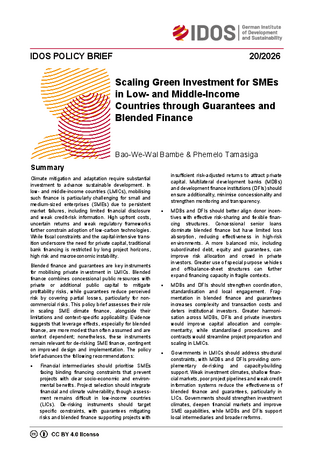
Climate mitigation and adaptation require substantial investment to advance sustainable development. In low- and middle-income countries (LMICs), mobilising such finance is particularly challenging for small and medium-sized enterprises (SMEs) due to persistent market failures, including limited financial disclosure and weak credit-risk information. High upfront costs, uncertain returns and weak regulatory frameworks further constrain adoption of low-carbon technologies. While fiscal constraints and the capital-intensive transition underscore the need for private capital, traditional bank financing is restricted by long project horizons, high risk and macroeconomic instability. Blended finance and guarantees are key instruments for mobilising private investment in LMICs. Blended finance combines concessional public resources with private or additional public capital to mitigate profitability risks, while guarantees reduce perceived risk by covering partial losses, particularly for non-commercial risks. This policy brief assesses their role in scaling SME climate finance, alongside their limitations and context-specific applicability. Evidence suggests that leverage effects, especially for blended finance, are more modest than often assumed and are context dependent; nonetheless, these instruments remain relevant for de-risking SME finance, contingent on improved design and implementation. The policy brief advances the following recommendations:
- Financial intermediaries should prioritise SMEs facing binding financing constraints that prevent projects with clear socio-economic and environmental benefits. Project selection should integrate financial and climate vulnerability, though assessment remains difficult in low-income countries (LICs). De-risking instruments should target specific constraints, with guarantees mitigating risks and blended finance supporting projects with insufficient risk-adjusted returns to attract private capital. Multilateral development banks (MDBs) and development finance institutions (DFIs) should ensure additionality, minimise concessionality and strengthen monitoring and transparency.
- MDBs and DFIs should better align donor incentives with effective risk-sharing and flexible financing structures. Concessional senior loans dominate blended finance but have limited loss absorption, reducing effectiveness in high-risk environments. A more balanced mix, including subordinated debt, equity and guarantees, can improve risk allocation and crowd in private investors. Greater use of special purpose vehicles and off-balance-sheet structures can further expand financing capacity in fragile contexts.
- MDBs and DFIs should strengthen coordination, standardisation and local engagement. Fragmentation in blended finance and guarantees increases complexity and transaction costs and deters institutional investors. Greater harmonisation across MDBs, DFIs and private investors would improve capital allocation and complementarity, while standardised procedures and contracts would streamline project preparation and scaling in LMICs.
Governments in LMICs should address structural constraints, with MDBs and DFIs providing complementary de-risking and capacity-building support. Weak investment climates, shallow financial markets, poor project pipelines and weak credit information systems reduce the effectiveness of blended finance and guarantees, particularly in LICs. Governments should strengthen investment climates, deepen financial markets and improve SME capabilities, while MDBs and DFIs support local intermediaries and broader reforms.
Weitere IDOS-Expert*innen zu diesem Thema
-
Baumann, Max-Otto
Politikwissenschaft
-
Berensmann, Kathrin
Wirtschaftswissenschaften
-
Fasold, Maximilian
Politische Ökonomie
-
Hackenesch, Christine
Politikwissenschaft
-
Haldenwang, Christian von
Politikwissenschaftler
-
Hilbrich, Sören
Ökonomie
-
Janus, Heiner
Politikwissenschaft
-
Keijzer, Niels
Sozialwissenschaft
-
Koch, Svea
Sozialwissenschaft
-
Mathis, Okka Lou
Politikwissenschaftlerin
-
Mchowa, Chifundo
Entwicklungsökonomie
-
Schiller, Armin von
Politikwissenschaftler
-
Schwachula, Anna
Soziologie
-
Sommer, Christoph
Ökonom
-
Srigiri, Srinivasa Reddy
Agrarökonom
-
Toto, Elisa Priscilla
Sustainable Development
-
Vogel, Johanna
Kulturwirtschaft
-
von Haaren, Paula
Entwicklungsökonomie
-
Walle, Yabibal
Entwicklungsökonomie
-
Wehrmann, Dorothea
Soziologie