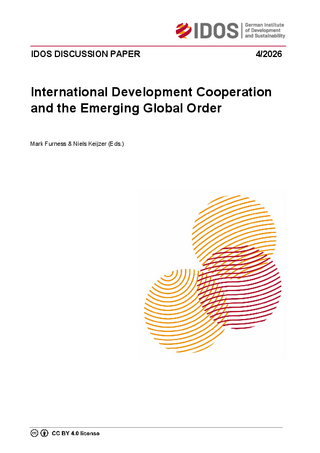
International development cooperation and the emerging global order
Furness, Mark / Niels Keijzer (eds.)Discussion Paper (4/2026)
Bonn: German Institute of Development and Sustainability (IDOS)
ISBN: 978-3-96021-288-1
DOI: https://doi.org/10.23661/idp4.2026
A little more than a year into the Trump 2.0 era, the “post–Cold War” international order as we know it is coming to an end. Amid increasing volatility and conflict, the shape and character of the order that will replace it are dangerously unclear. There are ambitions by so-called middle powers – including some member states of the EU – to provide an effective response, but questions remain as to their potential impact. Three scenarios can be envisaged: (1) an Orwellian dystopia dominated by three global powers – the United States, China and Russia – each with its own sphere of influence; (2) a “new Cold War” between two rival capitalist models: “Western” liberal democracy versus “Eastern” oligarchy and (3) the survival of the rules-based international order, possibly as a counterweight to oligarchic spheres of influence. For this scenario to materialise, middle powers must address the liberal order’s inherent weaknesses so that it delivers for all of its members. This discussion paper brings together 14 contributions drawing on the German Institute of Development and Sustainability’s (IDOS) broad regional and thematic expertise to examine these questions. The contributions analyse key actors, cooperation themes and regions. Each contribution analyses the implications of the changing global order for its specific area of focus and explores how international cooperation in general – and development cooperation in particular – can contribute to a more just and sustainable international system. The paper aims to provide readers with a range of perspectives on the state of international development cooperation and its possible evolution. Taken together, the contributions provide insights into the roles that international development cooperation may play in an emerging global order and identify priorities for reforms.
About the IDOS authors
Further IDOS experts
-
Baumann, Max-Otto
Political Science
-
Baydag, Melis
Political Science
-
Berensmann, Kathrin
Economy
-
Bergmann, Julian
Political Science
-
Dang, Vy
Political Science
-
Erforth, Benedikt
Political Science
-
Fasold, Maximilian
Political Economy
-
Grimm, Sven
Political Science
-
Hackenesch, Christine
Political Science
-
Haldenwang, Christian von
Political Science
-
Hilbrich, Sören
Economy
-
Janus, Heiner
Political Science
-
Koch, Svea
Social Science
-
Löpelt, Sarah
International relations and Sustainability policy
-
Mchowa, Chifundo
Development Economics
-
Olekseyuk, Zoryana
Economy
-
Schiller, Armin von
Political Science
-
Sommer, Christoph
Economist
-
Toto, Elisa Priscilla
Sustainable Development
-
von Haaren, Paula
Development Economics
-
Walle, Yabibal
Development Economics