The relationship between state fragility and refugees
Martin-Shields, CharlesExternal Publications (2023)
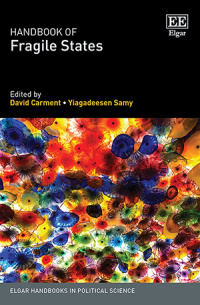
in: David Carment / Yiagadeesen Samy (eds.), Handbook of Fragile States, Cheltenham: Edward Elgar Publishing, 192-204
Our understanding of how state fragility leads to new refugee flows and displacement continues to empirically and theoretically evolve. When a state is fragile, lacking in administrative, social, and security capacity, the population is more likely to be forced to seek safety and economic opportunity elsewhere. The goal of this chapter is to provide background on the current research on refugee movements and state fragility, and use new quantitative measures of the latter to highlight where new research opportunities exist. It is well established that violence is the dominant factor in forcing people to leave their homes, and is the most commonly accepted reason states grant refugees asylum. However, using a novel dataset on different constellations of fragile states, we see that a substantial number of people also decide to move between states characterized by a low capacity to provide basic public services. This chapter closes with suggestions for new research directions while also outlining the practical implications for developing national and international policies that address how state fragility leads to forced displacement and new refugees.
About the IDOS author

Further IDOS experts
-
Abedtalas, Musallam
Economics
-
Bergmann, Julian
Political Science
-
Christ, Simone
Social Anthropology
-
Ekoh, Susan S.
Environmental Research
-
Erforth, Benedikt
Political Science
-
Fiedler, Charlotte
Political Scientist
-
Flaig, Merlin
Social Science
-
Furness, Mark
Political Science
-
Jaji, Rose
Anthropology
-
Kuhnt, Jana
Development Economist
-
Leininger, Julia
Political Scientist
-
Lorch, Jasmin
Political Science
-
Mross, Karina
Political Science
-
Putz, Lena-Marie
Peace and Conflict Research