
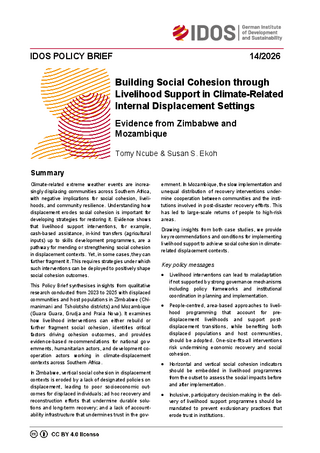
Building social cohesion through livelihood support in climate-related internal displacement settings: evidence from Zimbabwe and Mozambique
Ncube, Tomy / Susan S. EkohPolicy Brief (14/2026)
Bonn: German Institute of Development and Sustainability (IDOS)
DOI: https://doi.org/10.23661/ipb14.2026
Climate-related extreme weather events are increa-singly displacing communities across Southern Africa, with negative implications for social cohesion, livelihoods, and community resilience. Understanding how displacement erodes social cohesion is important for developing strategies for restoring it. Evidence shows that livelihood support interventions, for example, cash‑based assistance, in-kind transfers (agricultural inputs) up to skills development programmes, are a pathway for mending or strengthening social cohesion in displacement contexts. Yet, in some cases, they can further fragment it. This requires strategies under which such interventions can be deployed to positively shape social cohesion outcomes.
This Policy Brief synthesises insights from qualitative research conducted from 2023 to 2025 with displaced communities and host populations in Zimbabwe (Chimanimani and Tsholotsho districts) and Mozambique (Guara Guara, Grudja and Praia Nova). It examines how livelihood interventions can either rebuild or further fragment social cohesion, identifies critical factors driving cohesion outcomes, and provides evidence-based recommendations for national governments, humanitarian actors, and development co-operation actors working in climate-displacement contexts across Southern Africa.
In Zimbabwe, vertical social cohesion in displacement contexts is eroded by a lack of designated policies on displacement, leading to poor socioeconomic outcomes for displaced individuals; ad hoc recovery and reconstruction efforts that undermine durable solutions and long-term recovery; and a lack of accountability infrastructure that undermines trust in the government. In Mozambique, the slow implementation and unequal distribution of recovery interventions undermine cooperation between communities and the institutions involved in post-disaster recovery efforts. This has led to large-scale returns of people to high-risk areas.
Drawing insights from both case studies, we provide key recommendations and conditions for implementing livelihood support to achieve social cohesion in climate-related displacement contexts.
Key policy messages
• Livelihood interventions can lead to maladaptation if not supported by strong governance mechanisms including policy frameworks and institutional coordination in planning and implementation.
• People-centred, area-based approaches to livelihood programming that account for pre-displacement livelihoods and support post-displacement transitions, while benefiting both displaced populations and host communities, should be adopted. One-size-fits-all interventions risk undermining economic recovery and social cohesion.
• Horizontal and vertical social cohesion indicators should be embedded in livelihood programmes from the outset to assess the social impacts before and after implementation.
• Inclusive, participatory decision-making in the delivery of livelihood support programmes should be mandated to prevent exclusionary practices that erode trust in institutions.
Dr Tomy Ncube is a postdoctoral researcher affiliated with the Centre for International Development Innovation at the Ryan Institute, University of Galway, and the School of Geography, Archaeology and Irish Studies.
About the IDOS author

Further IDOS experts
-
Aleksandrova, Mariya
Climate risk governance
-
Bambe, Bao-We-Wal
Finance
-
Brandi, Clara
Economy and Political Science
-
Donnelly, Aiveen
Politcal Science
-
Fuhrmann-Riebel, Hanna
Economy
-
Goedeking, Nicholas
Comparative Political Economy
-
Hagenström, Paul
International Relations
-
Kativu, Saymore Ngonidzashe
Geography
-
Lehmann, Ina
Political Science
-
Malerba, Daniele
Economy
-
Mathis, Okka Lou
Political Scientist
-
Never, Babette
Political Scientist
-
Nowack, Daniel
Political Science
-
Pegels, Anna
Economist
-
Rodríguez de Francisco, Jean Carlo
Ecological economics
-
Roll, Michael
Sociology
-
Roost, Stefanie
Economics
-
Sakketa, Tekalign Gutu
Agricultural / Development Economics
-
Srigiri, Srinivasa Reddy
Agricultural Economist
-
Wagner, Niklas
Climate & Knowledge Sociology
-
Walle, Yabibal
Development Economics
-
Yi, HyunAh
Energy and Environmental Policy
-
Zintl, Tina
Political Scientist