Technischer Sicherheitsvorfall im Juli 2026 am IDOS
Update, Bonn, 20. August 2026. Wir sind wieder per Mail erreichbar. Aktuelle Informationen zum im Juli 2026 erfolgten Angriff auf eine Netzwerkkomponente des IDOS finden Sie hier.
Mehr lesen

Disruption und Reform
Angesichts globaler Krisen und zunehmender disruptiver, autoritärer Politikformen sind zukunftsorientierte, kooperative Reformen notwendig, um nachhaltige Entwicklung, internationale Zusammenarbeit und demokratische Grundlagen zu sichern. In diesem Special finden Sie Arbeiten von IDOS rund um die Dynamiken unseres Jahresthemas 2025/26 „Disruption und Reform“.

Globale Gesundheit stärken
Angesichts des größten Ausbruchs von Ebola in der Demokratischen Republik Kongo wird deutlich, wie wichtig internationale Kooperation bei der Bekämpfung von Gesundheitskrisen ist. IDOS untersucht, welche Faktoren entscheidend sind, um globale Solidarität im Gesundheitsbereich zu stärken und Gesundheitskrisen weltweit wirksam zu begegnen.
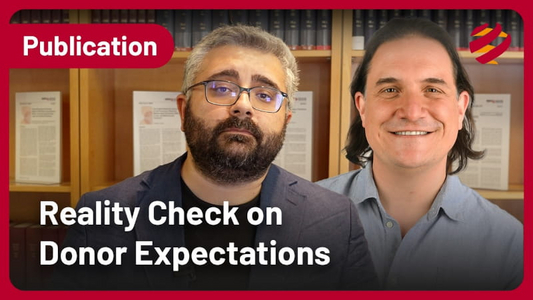
YouTube Video: Reality Check on Donor Expectations
IDOS beim Tag der offenen Tür im BMZ Bonn, 5. September
Besuchen Sie uns am IDOS-Stand zwischen 10 und 19 Uhr!
Unsere Expertise zu Nordafrika und dem Nahen Osten sowie zu weiteren Themen
Meinungs- und Medienbeiträge
Der Weg für arme Länder aus der Schuldenfalle
06.08.2026: Etwa die Hälfte der einkommensschwachen Länder ist derzeit zahlungsunfähig oder hat ein großes Risiko, zahlungsunfähig zu werden. Was die Weltgemeinschaft dagegen tun muss, erläutert eine IDOS-Wissenschaftlerin.
Mehr lesenBetween Shock and Opportunity: Hormuz and Deepening North Africa–Europe Relations
With the world’s attention fixed on the Strait of Hormuz, developments in North Africa have made fewer headlines in Europe. The crises in the Middle East are likely to deepen the geostrategic interdependence of North Africa and Europe, creating opportunities for both regions.
Mehr lesenVeranstaltungen
Ulaanbaatar, 28.08.2026
Geneva / Bern, 16.09.2026 bis 18.09.2026
Aktuelle Publikationen
Violence against women: translating rhetoric into action
Hampel-Milagrosa, AiméeDie aktuelle Kolumne (2009)
Bonn: German Development Institute / Deutsches Institut für Entwicklungspolitik (DIE) (Die aktuelle Kolumne vom 23.11.2009)
Bonn, 23.11.2009. Ten years ago the United Nations General Assembly designated 25 November as the International Day for the Elimination of Violence against Women. On this occasion, I am reminded of a conversation I once had in Accra that left a profound impact on my perception of what domestic life for women could be and how far along Ghana is, in translating UN rhetoric into reality.
In front of me sat Susan L., former programme manager of the Ark Foundation, an organization that offers marginalized and abused women a refuge of safety. She calmly explained how she once supervised the crisis centre, legal centre and shelter for abused women for the organization. According to Susan L., domestic violence, comprising of physical, emotional and psychological abuse were the most common types of cases that she encountered at work. She clarified that domestic abuse to women come in a variety of forms, ranging from as simple as non-communication imposed by the husband, to heavy physical aggression requiring hospitalization. Between spouses, domestic abuse could arise from the one-sided arbitrary aggression of the husband, to misunderstandings regarding the wife’s economic or social achievement that perhaps went beyond his own capacities. Ghanaian men prefer to be the head of the household, she said, and husbands fear that when wives are economically empowered, society will judge them as incapable and not in-charge.
Sadly, in Ghana, women who experienced severe injuries related to violence (including violence perceived by society as shameful such as rape or sodomy) still have to pay the hospital to obtain medical treatment. If the victims do not have the financial means to pay for the treatment, hospitals reserve the right to turn them away. The Ark Foundation encountered several instances when women went to the police station to report physical abuse from their husbands, only to be turned away by law enforcement officers with the advice to settle the issue privately with her spouse.
After independence, Ghana was party and signatory to several international agreements that recognized women’s significant contribution to economic development, provided equal opportunities for women to empower them, and condemned all forms of human rights violations against women, including physical abuse. As in most of Africa, however, Ghanaian society regards women’s reproductive and domestic responsibility desirable above all other traits. Although gender parity in primary and secondary education in Ghana is one of the highest in Sub Saharan Africa, young women leave the educational system in response to social pressure regarding marriage and childbearing. Thus, even if Ghanaian women belong among the more socially and economically privileged people in Sub-Saharan Africa, empowered women who go against the grain are tempting domestic abuse.
In July 2009, two weeks before my trip to Ghana, US President Barack Obama was on a diplomatic trip to Accra to highlight American support for the country’s efforts on good governance and emphasise the correlation between strong accountable institutions and economic prosperity. However, from what I heard from Susan L., it appears as if modern Ghanaian women still need to make a choice between participating actively and productively in the economy (risking violence from the husband or the family) and remaining subordinate or domestic. This appears to contradict the accepted outlook of researchers and policymakers worldwide that economic prosperity also brings forth progress in defining women’s role in the family and society.
Part of the problem lies in Ghana’s dual legal system. Ghanaian constitution provides for the recognition of customary law alongside common law. Unfortunately, when customary law provides the immediate family with the right to rectify the women in case she fails to fulfil reproductive and domestic expectations, then the constitution has indirectly underscored one basis for violence against women. Economics Nobel Laureate Oliver Williamson argued that norms and practices that evolve within society are so powerful that they take precedence over regulation. This means that Ghana needs to re-think its position with regard to which set of laws take primacy in the country and what expectations does Ghanaian society have from its women.
In his state visit, US President Obama also hailed Ghana as a role model for other African countries in observing the rule of law. True enough, there are now legal alternatives in the country where women could turn to for help in case of domestic abuse. The “Domestic Violence against Women Act” that recognizes all forms of spousal abuse as a criminal deed punishable by law was recently passed by the government. Once the new “Spousal Bill” is passed, it will make it legally unlawful for a husband to throw out his wife and devoid her of marital possessions on the basis of dissatisfaction with her domestic accomplishments alone. Following the statements of eloquent Mr. Obama, I enjoin the Ghanaian government and other governments of the world to continue to recognize violence against women as a social ill and to strive to protect them with the rule of law even in the face of resistance from deep-rooted traditional gender biases.
Newsletter
Melden Sie sich hier für unseren monatlichen Newsletter an und bleiben Sie über alle wichtigen Neuigkeiten aus dem German Institute of Development and Sustainability (IDOS) informiert. Der Newsletter liefert Ihnen Informationen zu neuen Publikationen, Forschungsprojekten, Veranstaltungen und Stellenangeboten.
IDOS-Newsletter Juni / Juli 2026
Jetzt anmelden