Flagship Report Disruption & Reform
New IDOS publication identifies pathways to rebuild international cooperation in times of disruption and to advance sustainable futures.
Read more

AI and Development Cooperation
Artificial intelligence (AI) systems can now decide and act autonomously. Research at IDOS focuses on their development in three key areas.

Sustainable Urban Development
Urban October focuses on sustainable and liveable cities. Our special collection, “Sustainable Urban Development,” brings together IDOS analyses, research findings, and policy recommendations on urbanisation, climate adaptation, mobility, housing, and social inclusion. Explore current perspectives on shaping the cities of tomorrow.
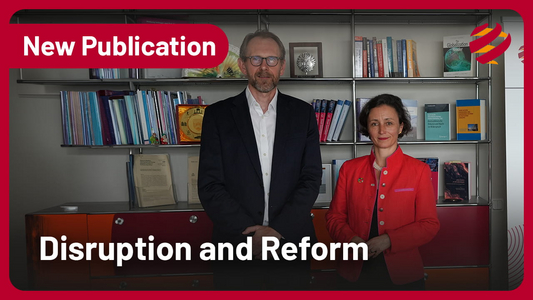
YouTube Video: Disruption and Reform
New WBGU Special Report “Social Cohesion Strengthens Security” published.
Blog: Private Sector Mobilisation: Are We Missing the Bigger Picture?
Press release of 12 October: Länderbericht zu Steuervergünstigungen in Deutschland
Our expertise on the Middle East and North Africa (Mena) as well as on other topics
Opinion pieces and media contributions
What can development partners do to help national development banks?
Successful partnerships should be measured by both the banks’ financial and institutional capacity to invest in sustainable development at scale.
Read moreThe global pullback from foreign aid
Global foreign aid is shrinking at a historic rate, according to the Organization for Economic Co-operation and Development (OECD). German political scientiest Stephan Klingebiel says it may not just be concerns about defence or public spending that is driving these cutbacks: "I think this kind of rise of pupulism in European countries is the main driver".
Read moreEvents
Bonn, 15.10.2026 until 16.10.2026
Bonn, 29.10.2026
Aachen, 05.11.2026
Current publications
Fighting tax fraud and avoidance must be part of the global Post-2015 agenda
von Haldenwang, Christian / Uwe Kerkow(2013)
Bonn: German Development Institute / Deutsches Institut für Entwicklungspolitik (DIE) (The Current Column of 15 July 2013)
Bonn, 15 July 2013. Reports on worldwide tax fraud and illicit global financial flows have been appearing more and more frequently in recent times, but the international community is still far from an effective system of controls. While it is true that the G20, the G8, the European Union (EU), the Organisation for Economic Co-operation and Development (OECD) and other international organisations are advocating more international cooperation and control in this area, implementation of the related resolutions has proven to be difficult.
In a <link t3: internal-link>major report published at the end of May 2013, the United Nations <link http: www.post2015hlp.org _blank>High-Level Panel of Eminent Persons on the Post-2015 Development Agenda now proposes that the reduction of illicit flows and tax evasion and the recovery of stolen assets be included in the new global agenda. This initiative deserves support, precisely because many of the poorer countries suffer from a disastrous combination of weak national tax and control agencies together with international tax loopholes and regulatory gaps.
<link t3: internal-link>Large international companies in particular use this constellation to shift their profits with the help of internal transfer prices to countries with very low tax burdens (so-called “tax havens”). An important mechanism employed in this context is the discretionary setting of internal prices for goods and services traded within a company or consortium on a cross-country basis (transfer pricing).
All over the world, tax authorities struggle to monitor transfer prices even for standardised products – not to mention highly specific financial services or internally licensed intellectual property rights. Poor countries with weak public sectors are often particularly challenged to address transfer pricing because of the large disproportion between the market power of the large companies and the limited capacities of domestic tax and control authorities.
Also, it is often much too easy for individuals with large private assets to dodge tax obligations in their own countries. Members of the elite tend to use their position to block investigations by national tax authorities. Once the funds have left the country, lax controls in “tax havens” help to conceal the origin of such wealth. As a result, some of the world's wealthiest persons come from very poor (but often resource-rich) countries with bad governance.
No reliable figures are available about the extent to which developing countries are damaged by such behaviour, but even the most conservative estimates make it clear that these illicit capital outflows lie on an order of several magnitudes above inflows from official development assistance (ODA). In addition to this direct effect, illicit capital flows have considerable (though difficult to quantify) negative impacts regarding governance and corruption – in the countries of origin as well as in receiving countries.
Most of the “tax havens” are found in OECD countries or small states and territories which are dependent on them. At the same time, it is the OECD countries which have the market power and public infrastructure to effectively implement controls and plug existing legal tax loopholes. But the major emerging powers too, along with resource-rich developing countries, must be integrated into this effort if actions which have been decided upon are to take effect on a worldwide basis. This topic is thus particularly relevant for a global agenda “beyond aid”.
What can be done?
As a first step, international cooperation among tax authorities must be further improved. Automatic exchange of information should become the general norm. In April 2013 the finance ministers of the six largest EU countries (Germany, France, the UK, Italy, Spain and Poland) signalled their readiness to orient themselves to the Fair and Accurate Credit Transactions Act (FACTA) of the USA from the year 2003 and to set up an automatic exchange of information on capital income. Beyond this, however, it is crucial to involve the major emerging powers and resource-rich developing countries. There has been almost no discussion of this to date.
Secondly, the responsibilities of companies regarding bookkeeping, accounting and reporting must be expanded and harmonised. In order to make internal transfer pricing and profit shifting transparent, mandatory disclosure is under discussion, above all on a project-by-project and country-by-country basis. This is where sectoral initiatives like the <link t3: internal-link>Extractive Industries Transparency Initiative (EITI) play a trailblazing role. The disclosure obligations anchored in the U.S. Dodd-Frank Act of 2010 for extractive industries also represent an important step on the road to more transparent financial behaviour on the part of multinational companies. This is all the more true as the EU Parliament, Commission and Council jointly launched a comparable directive in April 2013.
A third important measure would be to oblige every corporate entity recognised as such by law – including corporations, trusts and foundations – to procure and provide information about natural persons who profit from that entity's activities (beneficial ownership). The lack of such information is the central business basis of “tax havens”, which often advertise that the asset-holder's true identity must not be revealed. This is a point where resistance to reforms (or the gap between formal rules and their effective implementation) is thus especially strong.
Finally, additional steps to harmonise tax regimes and financial market regulations are required. Large companies often use country-specific rules and diverging interpretations of laws to lower their tax burden. In addition, it is now customary to situate valuable intellectual property with company subsidiaries in low-tax countries so that profits from the use of property rights accumulate there. An important aspect of harmonisation in light of this would be a uniform basis for the assessment of corporate income tax, with the aim that company profits should be taxed at the place where real value added does in fact occur. Even within the EU, this approach has not yet been fully implemented.
In recent years, the conditions for fighting tax fraud and avoidance on a global scale appear to be improving. However, international initiatives still fall short of causing a broad-based change in behavioural patterns. The issue has finally been seized by public debate – now it has to be incorporated in international regimes and, above all, implemented in the everyday operations of national tax and control agencies.
About the IDOS author

Further IDOS experts
-
Bambe, Bao-We-Wal
Finance
-
Baumann, Max-Otto
Political Science
-
Berensmann, Kathrin
Economy
-
Fasold, Maximilian
Political Economy
-
Hackenesch, Christine
Political Science
-
Hilbrich, Sören
Economy
-
Janus, Heiner
Political Science
-
Keijzer, Niels
Social Science
-
Koch, Svea
Social Science
-
Mathis, Okka Lou
Political Scientist
-
Mchowa, Chifundo
Development Economics
-
Schiller, Armin von
Political Science
-
Schwachula, Anna
Sociology
-
Sommer, Christoph
Economist
-
Srigiri, Srinivasa Reddy
Agricultural Economist
-
Toto, Elisa Priscilla
Sustainable Development
-
Vogel, Johanna
International Cultural Economy
-
Volz, Ulrich
Economist
-
von Haaren, Paula
Development Economics
-
Walle, Yabibal
Development Economics
-
Wehrmann, Dorothea
Sociology
Newsletter
Sign up here for our monthly newsletter and stay informed about all the important news from the German Institute of Development and Sustainability (IDOS). The newsletter provides you with information on new publications, research projects, events and job vacancies.
IDOS-Newsletter September 2026
Subscribe now