Flagship Report Disruption & Reform
New IDOS publication identifies pathways to rebuild international cooperation in times of disruption and to advance sustainable futures.
Read more

AI and Development Cooperation
Artificial intelligence (AI) systems can now decide and act autonomously. Research at IDOS focuses on their development in three key areas.
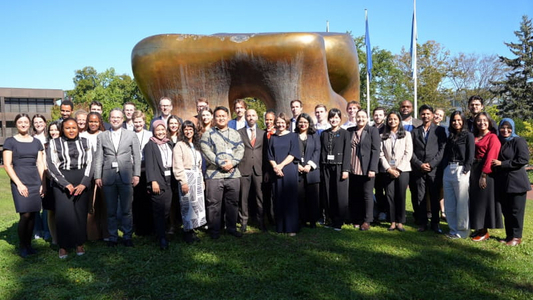
Welcome at IDOS!
This week, the participants of the Managing Global Governance (MGG) Academy 2026 started at IDOS. We look forward to meeting everyone and sharing ideas in the coming weeks!
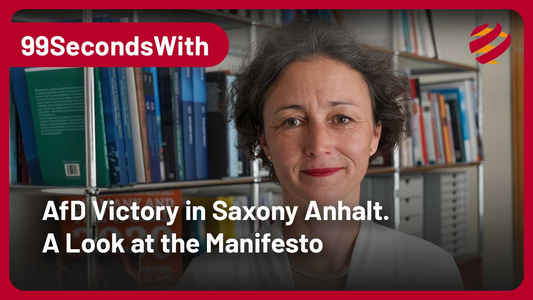
YouTube Video: #99SecondsWith Prof. Dr. Anna-Katharina Hornidge: The elections in Sachsen-Anhalt
You can find information about the technical security incident here
Press release of 21 September: Global cooperation under pressure – new report on shaping reforms
Our expertise on the Middle East and North Africa (Mena) as well as on other topics
Opinion pieces and media contributions
Why the Indus Waters Treaty must be abided by
A continued suspension of the Indus Waters Treaty could weaken international water law and contribute to the erosion of international law.
Read moreAgree to disagree: why the AU and the EU should engage in pragmatic partnerships
The AU–EU partnership should embrace the plurality within both unions, make interests transparent, and enable pragmatic cooperation between coalitions of willing countries, helping to bring proclaimed ambitions closer to actual practice, say Benedikt Erforth and Lena Gutheil.
Read moreEvents
Bonn, 23.09.2026
Current publications
Footprints: taking the right steps towards global sustainability
Figueroa, Aurelia(2012)
Bonn: German Development Institute / Deutsches Institut für Entwicklungspolitik (DIE) (The Current Column of 13 August 2012)
Bonn, 13 August 2012. Carbon footprint, a measurement of the total greenhouse gas (GHG) emissions of an entity, is proving to be one of the great buzzwords of the 21st century. Yet, in order to reach many of the achievements which are required to shrink carbon footprints – and more broadly, address global challenges – still another footprint must be addressed in order to ensure social acceptance and, correspondingly, implementation: the psychological footprint.
Traditionally used in the context of stress caused by disasters, a psychological footprint is intangible, emotional residue. It is meaningful, especially to the person by which it is perceived. In the context of global challenges, it is particularly relevant as many proposed or existing technologies, innovations, and policies are still psychologically unpalatable.
Psychological footprints deal with concerns ranging from frivolous to serious. For example, many would contend the reluctance of a teenager to drive an “uncool” fuel efficient vehicle with lower carbon emissions to be a frivolous complaint. On the serious side, an example would be the challenges presented to herd immunity by the reluctance of some to be inoculated due to fears related to past vaccine scandals.
Unfortunately, even in the case of concerns which may be perceived as frivolous, once these psychological footprints present themselves, they are barriers that must be surmounted in order to gain public buy-in for a potential solution. We are continuing to see that the question of how policy and technology solutions can be made socially acceptable is one of the great challenges of our time. It simply cannot be assumed that if something is invented, innovated, or legislated, it will be implemented. As such, learning from existing examples in shrinking psychological footprints can be beneficial.
Addressing the psychological footprint through technological or social solutions
Wastewater treatment (WWT) plants, a necessary public infrastructure for sanitation and public water provision, frequently face protest due to their typically associated psychological footprint, stemming from both the odours and eyesores with which they are commonly associated. By addressing these challenges through innovation, a Hungarian firm has wiped away the psychological footprint and created a new paradigm in WWT. This is done by introducing ecosystems into the WWT plant, which both removes odour and provides attractive WWT infrastructure which includes a green space. Promoting their small psychological footprint as a competitive advantage, this firm has realised uptake of its technology in several countries.
Sometimes, however, technological solutions to psychological footprints may not be available, thereby increasing the focus on solutions related to social aspects. One example of this is Samsø Island in Denmark, where the transition to carbon neutrality has been realised. Samsø was able to gain support for its transition to carbon neutrality by catalysing unconventional inclusion, giving residents a role in the transformation and thereby addressing the psychological footprint of introducing wind farms on a picturesque island, inter alia. Local and co-ownership, including tangible economic benefits, are examples of the importance placed on the social relation in the Samsø transformation and are credited as playing a prominent role in securing buy-in and legitimacy for this transformation.
One raison d’être of not in my backyard (NIMBY) protesters is related to the market failure of public goods: who wants to burden the responsibility of having a WWT plant or wind turbine in the backyard when the benefits are shared by a broader group? When the psychological footprint may not be addressed through technological innovations as in the case of Organica, and the benefit/burden imbalance remains, other measures may be used to address the political economy, as is demonstrated by Samsø Island. Indeed, even when the psychological footprint has been reconciled through technology-based solutions, the social aspects of the psychological footprint should still be addressed.
Two sides of the same footprint
The psychological footprint can also be harnessed in favour of global challenges. Empirical evidence indicates that well educated consumers are willing to undertake additional efforts (waste recycling) or pay higher prices for ethically produced products (e.g. Fair Trade) for the associated instrumental value. This illustrates the other side of the psychological footprint, in which it can work in favour of global challenges, as manifested by the conscious consumer. In short, psychological footprints can act both “for” and “against” global challenges. In the first instance, it plays an important role in informing consumption habits. In the second instance, it can be a powerful barrier to implementation.
Case in point
Looming large in the German Energiewende and a broader global energy transformation is the psychological footprint. So many of the technological solutions necessary for a transformation fall victim to NIMBY protesters (among other opponents): electrical grid expansions, wind farms, or carbon capture and storage, to name but a few examples. Although requiring some extrapolation, Samsø and other examples present valuable lessons on successful implementation owing to social inclusion. In addition, it has been demonstrated that the psychological footprint can also be harnessed to impact consumption patterns and broader social behaviours to the benefit of global challenges.
The elements necessary to remove the psychological footprint or to impact behaviours will be case sensitive. However, as is seen above, this can be realised through technology, innovation, local ownership and co-ownership. These elements provide a balance between benefit and burden sharing which eases implementation by encouraging buy-in. Although buzzwords come and go, the larger concepts they concisely portray remain. Whether psychological footprint likewise becomes a buzzword of the 21st century is unclear. Regardless, the relevance of the impact of the psychological footprint will remain. It must be both reconciled and harnessed to the benefit of global challenges and realise resilience.
Further IDOS experts
-
Aleksandrova, Mariya
Climate risk governance
-
Banerjee, Aparajita
Environmental and Resource Sociology, Public Policy
-
Brandi, Clara
Economy and Political Science
-
Dombrowsky, Ines
Economist
-
Donnelly, Aiveen
Politcal Science
-
Ekoh, Susan S.
Environmental Research
-
Fuhrmann-Riebel, Hanna
Economy
-
Goedeking, Nicholas
Comparative Political Economy
-
Hagenström, Paul
International Relations
-
Hein, Jonas
Geography
-
Hernandez, Ariel
Economy
-
Houdret, Annabelle
Political Scientist
-
Kativu, Saymore Ngonidzashe
Geography
-
Lehmann, Ina
Political Science
-
Malerba, Daniele
Economy
-
Mathis, Okka Lou
Political Scientist
-
Möschl, Tim
Governance
-
Never, Babette
Political Scientist
-
Pegels, Anna
Economist
-
Putz, Lena-Marie
Peace and Conflict Research
-
Rodríguez de Francisco, Jean Carlo
Ecological economics
-
Siriwardane-de Zoysa, Rapti
Sociology
-
Srigiri, Srinivasa Reddy
Agricultural Economist
-
Wagner, Niklas
Climate & Knowledge Sociology
-
Yi, HyunAh
Energy and Environmental Policy
Newsletter
Sign up here for our monthly newsletter and stay informed about all the important news from the German Institute of Development and Sustainability (IDOS). The newsletter provides you with information on new publications, research projects, events and job vacancies.
IDOS-Newsletter June / Juli 2026
Subscribe now