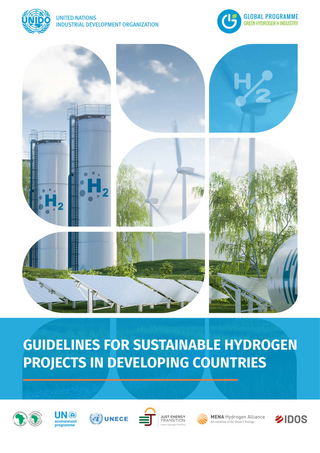
Guidelines for sustainable hydrogen projects in developing countries
UNIDO / UNEP / UNECE / AfDB / the JET Green Hydrogen Portfolio (South Africa) / IDOS / MENA Hydrogen AllianceExternal Publications (2025)
Vienna: United Nations Industrial Development Organisation (UNIDO)
Despite the potential of renewable hydrogen to galvanize economies and climate action, governments and development banks often lack a coherent framework to assess and approve hydrogen projects on sustainability grounds. Decision-making processes regarding land allocation, permitting and infrastructure access remain fragmented, increasing the risof extractive investment models that provide limited local benefits while causing environmental harm. Transparent, universally accepted sustainability guidelines can help decision makers select project partners that align with their respective priorities and objectives, including the UN Sustainable Development Goals (SDGs). Moreover, such a framework can enhance investor confidence and public trust by ensuring that hydrogen projects deliver tangible socioeconomic benefits to host communities. Recognizing this need, a broad coalition of stakeholders has collaborate to develop the Guidelines for Sustainable Hydrogen Projects, integrating expertise from multiple disciplines to create a flexible yet comprehensive decision-making tool. The Guidelines serve as a reference for governments, development banks and other stakeholders in evaluating hydrogen project proposals. Rather than prescribing rigid requirements, they provide a non-exhaustive set of criteria that can be adapted to local contexts. The Guidelines emphasize maximizing domestic value creation while safeguarding environmental and social standards. Applicable to large-scale projects with a minimum capacity of 200 megawatts (MW) - including renewable electricity generation, water desalination, electrolysis, and related infrastructure - they help ensure that hydrogen investments contribute to long-term sustainable development. By aligning with the SDGs, they promote inclusive economic growth, responsible resource management and climate action.
About the IDOS authors


Further IDOS experts
-
Altenburg, Tilman
Economic Geography
-
Asimeng, Emmanuel Theodore
Urban Planning, Sustainability
-
Banerjee, Aparajita
Environmental and Resource Sociology, Public Policy
-
Baumann, Max-Otto
Political Science
-
Baydag, Melis
Political Science
-
Berger, Axel
Political Science
-
Bergmann, Julian
Political Science
-
Brandi, Clara
Economy and Political Science
-
Büscher, Chris
Development studies / Political ecology
-
Dang, Vy
Political Science
-
El-Haddad, Amirah
Economy
-
Erforth, Benedikt
Political Science
-
Fuhrmann-Riebel, Hanna
Economy
-
Furness, Mark
Political Science
-
Grimm, Sven
Political Science
-
Hackenesch, Christine
Political Science
-
Janus, Heiner
Political Science
-
Keijzer, Niels
Social Science
-
Koch, Svea
Social Science
-
Kornher, Lukas
Economics
- Kötter, Elizabeth Chepkemboi
-
Loewe, Markus
Economy
-
Löpelt, Sarah
International relations and Sustainability policy
-
Never, Babette
Political Scientist
-
Olekseyuk, Zoryana
Economy
-
Pegels, Anna
Economist
-
Sommer, Christoph
Economist
-
Sowa, Alina
Economics
-
Stender, Frederik
Economics
-
Stöcker, Alexander
Economics
-
Vogel, Tim
Economy
-
von Haaren, Paula
Development Economics
-
Wende, Paulina
Political Science
-
Yi, HyunAh
Energy and Environmental Policy
-
Zintl, Tina
Political Scientist