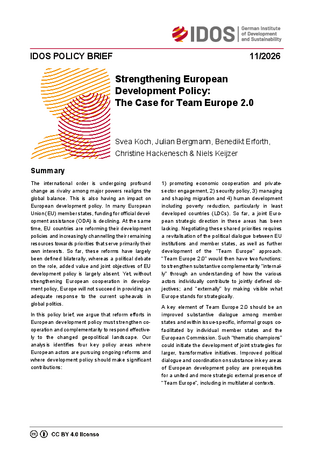
Strengthening European development policy: the case for Team Europe 2.0
Koch, Svea / Julian Bergmann / Benedikt Erforth / Christine Hackenesch / Niels /KeijzerPolicy Brief (11/2026)
Bonn: German Institute of Development and Sustainability (IDOS)
DOI: https://doi.org/10.23661/ipb11.2026
Dt. Ausg. u.d.T.:
Zusammen ist man weniger allein: Mit Team Europe 2.0 die europäische Entwicklungspolitik stärken
(Policy Brief 12/2026)
The international order is undergoing profound change as rivalry among major powers realigns the global balance. This is also having an impact on European development policy. In many European Union (EU) member states, funding for official development assistance (ODA) is declining. At the same time, EU countries are reforming their development policies and increasingly channelling their remaining resources towards priorities that serve primarily their own interests. So far, these reforms have largely been defined bilaterally, whereas a political debate on the role, added value and joint objectives of EU development policy is largely absent. Yet, without strengthening European cooperation in development policy, Europe will not succeed in providing an adequate response to the current upheavals in global politics.
In this policy brief, we argue that reform efforts in European development policy must strengthen co-operation and complementarity to respond effectively to the changed geopolitical landscape. Our analysis identifies four key policy areas where European actors are pursuing ongoing reforms and where development policy should make significant contributions:
1) promoting economic cooperation and private-sector engagement, 2) security policy, 3) managing and shaping migration and 4) human development including poverty reduction, particularly in least developed countries (LDCs). So far, a joint European strategic direction in these areas has been lacking. Negotiating these shared priorities requires a revitalisation of the political dialogue between EU institutions and member states, as well as further development of the “Team Europe” approach. “Team Europe 2.0” would then have two functions: to strengthen substantive complementarity “internally” through an understanding of how the various actors individually contribute to jointly defined objectives; and “externally” by making visible what Europe stands for strategically.
A key element of Team Europe 2.0 should be an improved substantive dialogue among member states and within issue-specific, informal groups co-facilitated by individual member states and the European Commission. Such “thematic champions” could initiate the development of joint strategies for larger, transformative initiatives. Improved political dialogue and coordination on substance in key areas of European development policy are prerequisites for a united and more strategic external presence of “Team Europe”, including in multilateral contexts.
About the IDOS authors




Further IDOS experts
-
Baumann, Max-Otto
Political Science
-
Baydag, Melis
Political Science
-
Dang, Vy
Political Science
-
Furness, Mark
Political Science
-
Grimm, Sven
Political Science
-
Janus, Heiner
Political Science
-
Löpelt, Sarah
International relations and Sustainability policy
-
Olekseyuk, Zoryana
Economy
-
von Haaren, Paula
Development Economics