
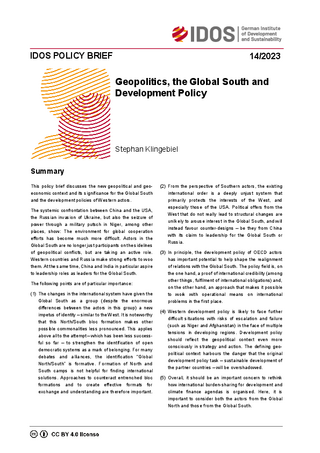
Geopolitics, the Global South and Development Policy
Klingebiel, StephanPolicy Brief (14/2023)
Bonn: German Institute of Development and Sustainability (IDOS)
DOI: https://doi.org/10.23661/ipb14.2023
Dt.. Ausg. u.d.T.:
Geopolitik, Globaler Süden und Entwicklungspolitik
(Policy Brief 12/2023)
This policy brief discusses the new geopolitical and geo-economic context and its significance for the Global South and the development policies of Western actors. The systemic confrontation between China and the USA, the Russian invasion of Ukraine, but also the seizure of power through a military putsch in Niger, among other places, show: The environment for global cooperation efforts has become much more difficult. Actors in the Global South are no longer just participants on the sidelines of geopolitical conflicts, but are taking an active role. Western countries and Russia make strong efforts to woo them. At the same time, China and India in particular aspire to leadership roles as leaders for the Global South. The following points are of particular importance:
(1) The changes in the international system have given the Global South as a group (despite the enormous differences between the actors in this group) a new impetus of identity – similar to the West. It is noteworthy that this North/South bloc formation makes other possible commonalities less pronounced. This applies above all to the attempt – which has been less success-ful so far – to strengthen the identification of open democratic systems as a mark of belonging. For many debates and alliances, the identification “Global North/South” is formative. Formation of North and South camps is not helpful for finding international solutions. Approaches to counteract entrenched bloc formations and to create effective formats for exchange and understanding are therefore important.
(2) From the perspective of Southern actors, the existing international order is a deeply unjust system that primarily protects the interests of the West, and especially those of the USA. Political offers from the West that do not really lead to structural changes are unlikely to arouse interest in the Global South, and will instead favour counter-designs – be they from China with its claim to leadership for the Global South or Russia.
(3) In principle, the development policy of OECD actors has important potential to help shape the realignment of relations with the Global South. The policy field is, on the one hand, a proof of international credibility (among other things, fulfilment of international obligations) and, on the other hand, an approach that makes it possible to work with operational means on international problems in the first place.
(4) Western development policy is likely to face further difficult situations with risks of escalation and failure (such as Niger and Afghanistan) in the face of multiple tensions in developing regions. Development policy should reflect the geopolitical context even more consciously in strategy and action. The defining geo-political context harbours the danger that the original development policy task – sustainable development of the partner countries – will be overshadowed.
(5) Overall, it should be an important concern to rethink how international burden-sharing for development and climate finance agendas is organised. Here, it is important to consider both the actors from the Global North and those from the Global South.
About the IDOS author

Further IDOS experts
-
Aleksandrova, Mariya
Climate risk governance
-
Bambe, Bao-We-Wal
Finance
-
Baumann, Max-Otto
Political Science
-
Baydag, Melis
Political Science
-
Berger, Axel
Political Science
-
Bergmann, Julian
Political Science
-
Brandi, Clara
Economy and Political Science
-
Dang, Vy
Political Science
-
Donnelly, Aiveen
Politcal Science
-
Ekoh, Susan S.
Environmental Research
-
Erforth, Benedikt
Political Science
-
Fuhrmann-Riebel, Hanna
Economy
-
Furness, Mark
Political Science
-
Goedeking, Nicholas
Comparative Political Economy
-
Grimm, Sven
Political Science
-
Hackenesch, Christine
Political Science
-
Hagenström, Paul
International Relations
-
Haug, Sebastian
Political Science
-
Hilbrich, Sören
Economy
-
Janus, Heiner
Political Science
-
Kativu, Saymore Ngonidzashe
Geography
-
Keijzer, Niels
Social Science
-
Koch, Svea
Social Science
-
Lehmann, Ina
Political Science
-
Löpelt, Sarah
International relations and Sustainability policy
-
Malerba, Daniele
Economy
-
Mathis, Okka Lou
Political Scientist
-
Never, Babette
Political Scientist
-
Olekseyuk, Zoryana
Economy
-
Pegels, Anna
Economist
-
Reiners, Wulf
Political Science
-
Rodríguez de Francisco, Jean Carlo
Ecological economics
-
Schwachula, Anna
Sociology
-
Srigiri, Srinivasa Reddy
Agricultural Economist
-
Vogel, Johanna
International Cultural Economy
-
von Haaren, Paula
Development Economics
-
Wagner, Niklas
Climate & Knowledge Sociology
-
Wehrmann, Dorothea
Sociology
-
Yi, HyunAh
Energy and Environmental Policy