Mobilising and scaling local climate action
Putz, Lena-Marie / Paula von Haaren / Axel Berger / Rafael de Moraes Baldrighi / Guísela PereiraPolicy Brief (5/2026)
Bonn: German Institute of Development and Sustainability (IDOS)
DOI: https://doi.org/10.23661/ipb5.2026
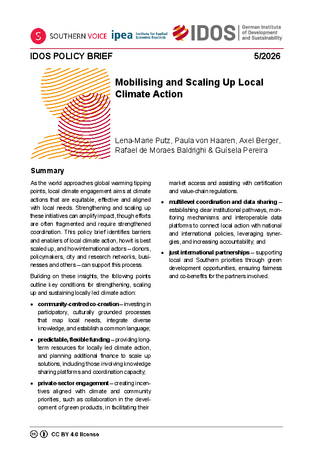
As the world approaches global warming tipping points, local climate engagement aims at climate actions that are equitable, effective and aligned with local needs. Strengthening and scaling up these initiatives can amplify impact, though efforts are often fragmented and require strengthened coordination. This policy brief identifies barriers and enablers of local climate action, how it is best scaled up, and how international actors – donors, policymakers, city and research networks, businesses and others – can support this process.
Building on these insights, the following points outline key conditions for strengthening, scaling up and sustaining locally led climate action:
• community-centred co-creation – investing in participatory, culturally grounded processes that map local needs, integrate diverse knowledge, and establish a common language;
• predictable, flexible funding – providing long-term resources for locally led climate action, and planning additional finance to scale up solutions, including those involving knowledge sharing platforms and coordi-nation capacity;
• private-sector engagement – creating incentives aligned with climate and community priorities, such as collaboration in the development of green products, in facilitating their market access and assisting with certification and value-chain regulations.
• multilevel coordination and data sharing – establishing clear institutional pathways, monitoring mechanisms and interoperable data platforms to connect local action with national and international policies, leveraging synergies, and increasing accountability; and
• just international partnerships – supporting local and Southern priorities through green development opportunities, ensuring fairness and co-benefits for the partners involved.
Rafael de Moraes Baldrighi is a senior researcher at the Institute for Applied Economic Research (Ipea).
Guísela Pereira is a project and research associate at Southern Voice.
About the IDOS authors


Further IDOS experts
-
Aleksandrova, Mariya
Climate risk governance
-
Asimeng, Emmanuel Theodore
Urban Planning, Sustainability
-
Bambe, Bao-We-Wal
Finance
-
Baumann, Max-Otto
Political Science
-
Baydag, Melis
Political Science
-
Bergmann, Julian
Political Science
-
Brandi, Clara
Economy and Political Science
-
Dang, Vy
Political Science
-
Donnelly, Aiveen
Politcal Science
-
Ekoh, Susan S.
Environmental Research
-
Erforth, Benedikt
Political Science
-
Fuhrmann-Riebel, Hanna
Economy
-
Furness, Mark
Political Science
-
Goedeking, Nicholas
Comparative Political Economy
-
Grimm, Sven
Political Science
-
Gutheil, Lena
Cultural Anthropology
-
Hackenesch, Christine
Political Science
-
Hagenström, Paul
International Relations
-
Janus, Heiner
Political Science
-
Jauregui Fung, Franco
Architecture, Urban Agglomerations
-
Kativu, Saymore Ngonidzashe
Geography
-
Keijzer, Niels
Social Science
-
Koch, Svea
Social Science
-
Lehmann, Ina
Political Science
-
Löpelt, Sarah
International relations and Sustainability policy
-
Malerba, Daniele
Economy
-
Mathis, Okka Lou
Political Scientist
-
Never, Babette
Political Scientist
-
Olekseyuk, Zoryana
Economy
-
Pegels, Anna
Economist
-
Rodríguez de Francisco, Jean Carlo
Ecological economics
-
Siriwardane-de Zoysa, Rapti
Sociology
-
Srigiri, Srinivasa Reddy
Agricultural Economist
-
Wagner, Niklas
Climate & Knowledge Sociology
-
Yi, HyunAh
Energy and Environmental Policy
-
Zumegen, Lisa
Urban Transformation